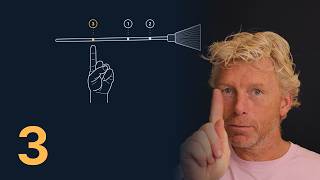
The centre of gravity is the point where gravity acts on an object, as if all its mass sits there. Support an object right below it and it stays balanced. For a broom it lies closer to the heavy brush. For a regular shape of one material it is in the middle, for a ring even in the hole.
This video can also be listened to in العربية, English, Français and Türkçe. Choose your language under the gear icon in the player, at Audio track and Subtitles.
A broom lies across your finger, balanced. Is your finger then exactly in the middle, closer to the brush, or closer to the end of the handle? Choose first, before you watch on.
You see what the centre of gravity is: the point where gravity acts on an object, as if all the mass sits there. Support an object right below its centre of gravity, and it stays balanced. Then where the centre of gravity is for a regular shape made of one material, like a block, a ball or a cylinder, and why for a ring it lies in the hole, where there is no material at all. Finally, how to find the centre of gravity of a small board with an irregular shape without calculating: hang it up twice, draw two lines, and where they cross is the centre of gravity.
For high school physics, in the chapter on forces. Halfway through there is a question and a pause: stop the video there and think for yourself first.
In this video
The full explanation, in writing
A broom on your finger
0:00A broom lies across your finger, balanced. Where is your finger: exactly in the middle, closer to the brush, or closer to the end of the handle? Just choose.
The point where gravity acts
0:17The centre of gravity is the point where gravity acts on an object. It is as if all the mass of the object sits in that one point. Support an object right below its centre of gravity, and it stays balanced. The brush is heavy and the handle is light.
0:34So the centre of gravity is not in the middle, but closer to the brush, and that is where your finger is.
The middle, and sometimes even beside it
0:42If an object has a regular shape and is made of the same material throughout, its centre of gravity is in the middle. For a block, for a ball, for a cylinder. For a ring, the middle is in the hole. So a ring's centre of gravity is in a place where there is no material at all.
1:01Your turn. A small board has an irregular shape. How do you find its centre of gravity, without calculating?
Hang it up twice
1:12Hang the board from one point, so that it can turn freely. It turns until the centre of gravity hangs right below the point it hangs from. From the same point, hang a thread with a small weight, and draw a line along that thread: the centre of gravity is somewhere on that line.
1:32Then hang the board from another point, and draw another line. Where the two lines cross is the centre of gravity.
Three things to remember
1:38Three things. The centre of gravity is the point where gravity acts on an object. Support it right below that point, and it stays balanced. For a regular shape made of one material, the centre of gravity is in the middle, and that can even be outside the material.
1:56And for an irregular shape, you find it by hanging the object up twice: where the two lines cross is the centre of gravity.
Two questions
2:04Two questions. One. Where is the centre of gravity of a solid wooden cube? Two. A hammer lies balanced on your finger. Is your finger closer to the head, or closer to the end of the handle?
The answers
2:21The first: exactly in the middle of the cube, because it has a regular shape and is made of the same wood throughout. The second: closer to the head. That is where most of the mass is, so that is where the centre of gravity is too.
Next: types of forces
2:35Do you want to know everything a force can do, and what types of forces there are? Then watch the video about types of forces on my YouTube channel.
Frequently asked questions
What is the centre of gravity?
The centre of gravity is the point where gravity acts on an object. It is as if all the mass of the object sits in that one point. Support an object right below its centre of gravity, and it stays balanced.
Why is the centre of gravity of a broom not in the middle?
Because the brush is heavy and the handle is light. There is more mass on the brush side, so the centre of gravity lies closer to the brush. That is where your finger has to be to keep the broom balanced.
Where is the centre of gravity of a ring?
In the middle of the hole. A ring has a regular shape and is made of the same material throughout, so its centre of gravity is in the middle, even though there is no material there at all.
How do you find the centre of gravity of a board with an irregular shape?
Hang the board from one point so that it can turn freely, and draw a line straight down along a thread with a small weight. Then hang it from another point and draw another line. Where the two lines cross is the centre of gravity.
Where is the centre of gravity of a hammer?
Closer to the head, because that is where most of the mass is. So a hammer lies balanced on your finger when your finger is close to the head, not in the middle of the handle.
The centre of gravity does not have to lie inside the material.
Physics with Thomas makes physics explainers for secondary school. No words on screen, so what you see works in any language.
In this series
 Types of forces3:06
 Calculating gravity3:15
 Centre of gravity2:48
 Force meter: range and precision3:11
 Elastic force and spring constant3:41
 Directly proportional relationship3:37
About me








My name is Thomas Schuurmans, and I have a passion for physics and for understanding why things work the way they do. What I want is to get young people asking “why is that?” and “how does that work?” more often, and to hand them the tools of physics in a way that is simple and that you can see.
I graduated in applied physics at Delft University of Technology in 2003. After that I spent more than twenty years outside education: first at TNO, the Dutch applied research institute, then at a design agency, and eventually founding Proportion Global, through which I work on innovation questions in Africa, Latin America and South Asia. That work resembles physics more than you would expect: don't start from a solution, first understand what is going on, try something, be wrong, and look again.
Since 2026 I have been teaching physics to both lower and upper secondary classes, and I started a master's at the University of Amsterdam for my full teaching qualification. That is where I learned that a secondary school pupil's real attention for new material lasts about seven minutes. And my own weakness happens to be telling too many side stories.
That is where the idea came from: videos that explain one topic sharply and visually, inside those seven minutes. I make them for my own pupils. Then I publish them, because good explanation should be within reach of anyone who needs it, wherever you live and whatever language you think and speak in.