
Sound is a vibration passed on from particle to particle. The air from someone's mouth never reaches your ear: the air particles only vibrate to and fro about their own place, and what travels is the vibration. For that a medium is always needed. In air of twenty degrees sound goes 343 metres per second.
This video can also be listened to in العربية, English, Español, Français, Português, Kiswahili and Türkçe. Choose your language under the gear icon in the player, at Audio track and Subtitles.
Someone is talking to you, two metres away. Air comes out of his mouth, that air arrives at your ear, and that is what you hear. Almost everyone chooses the same here, and most choose wrongly.
In seven minutes you see what sound really is. You learn that every source of sound vibrates, that the vibration needs a medium to be passed on, and why the particles themselves do not travel along while the sound wave does, exactly like the wave in a full stadium. Then comes the receiver: source, medium, receiver, the chain behind every sound you have ever heard. You see the speed of sound in air, water and steel, and why it is not about how closely the particles sit together but how firmly they are attached to each other. And then you calculate: how far away did the lightning strike, with v is s divided by t in five steps, plus the rule of thumb you never lose again.
For upper secondary physics, on the topic of sound. The video asks a question twice and then leaves a short silence: think for yourself there first, because the answer only comes afterwards.
In this video
- 0:00Is this right?
- 0:25Everything that makes sound vibrates
- 0:54The particles do not travel, the vibration does
- 2:10Which way does the wave travel?
- 2:23From ear drum to microphone: the receiver
- 2:55Where does sound go fastest: air, water or steel?
- 3:05343, 1480 and over 5000 metres per second
- 4:39How far away did the lightning strike?
- 5:06Calculating in five steps with v = s / t
- 5:32The rule of thumb for thunderstorms
- 5:45Three things to remember
- 6:08Two questions to try yourself
- 6:31The answers
The full explanation, in writing
Is this right?
0:00Someone is talking to you, a couple of metres away. Air comes out of his mouth, that air arrives at your ear, and that is what you hear. Is that right, yes or no? Take your time, because almost everyone chooses the same here. And most choose wrongly.
0:22All that makes sound vibrates.
Everything that makes sound vibrates
0:27Really everything: a tuning fork, a guitar string, your own vocal cords, the little plate in the speaker of your phone. Just look at this tuning fork. The prongs go to and fro past their rest position: outwards, back, inwards, back. That whole round, once, we call one vibration.
0:46And as long as it vibrates, you hear it. If I grab it, it is silent at once. No vibration, no sound.
The particles do not travel, the vibration does
0:54That vibration must now get to your ear. And for that something is needed to go through, an in-between substance: that we call the medium. Usually that is simply the air around you. Just look at the air particles. The prong of the tuning fork pushes against the particles beside it, they shift, bump into their neighbours and then spring back.
1:17And the neighbours do exactly the same. So that one push is passed on, particle by particle, all the way to your ear. Now pay very close attention, because this is where almost everyone is wrong: the particles themselves do not travel along.
1:35They only vibrate to and fro about their own place. What travels is the vibration. Exactly like the wave in a full stadium: nobody walks from left to right, and yet that wave goes round the whole stadium. One difference: in the stadium the people go up and down, across the direction of the wave.
2:00With sound the particles vibrate to and fro along the very line the wave travels. Such a passed-on vibration we call a sound wave.
Which way does the wave travel?
2:11Look once more at that one coloured particle. Which way does the wave travel, and how does that particle itself move? Exactly here sits the difference with the stadium wave.
From ear drum to microphone: the receiver
2:23At the end that wave arrives somewhere. With you that is your ear drum: a tight membrane that the arriving wave sets vibrating itself. That vibration becomes a signal that goes through your nerves to your brain, and only then do you hear it.
2:42Microphones do exactly the same, by the way, only there the vibration becomes an electrical signal. Source, medium, receiver: that chain sits behind every sound you have ever heard.
Where does sound go fastest: air, water or steel?
2:56First predict, then look. Where does sound go fastest, and where slowest: through air, through water, or through steel?
343, 1480 and over 5000 metres per second
3:07In air of twenty degrees sound goes 343 metres per second. That is fast, but it is nothing next to water: there it is 1480. And in steel over 5000 metres per second, fifteen times faster than through the air. That feels odd, because in steel everything is stuck fast, surely?
3:26But that is exactly why it goes so fast. It is not about how closely the particles sit together, but how firmly they are attached to each other. In steel they are coupled so strongly that a push is passed on at once, as if there were tight little springs between them.
3:48In air those springs are not there. There the particles float about freely and bump into each other, and then the vibration travels about as fast as the particles themselves move. That is a good deal slower. And note the unit, because there is a trap in it: with solids the speed is often given in kilometres per second.
4:11So 4,3 kilometres per second is 4300 metres per second. Not less than 343, but far more. One more thing, and then we start calculating: warmer air gives a higher speed of sound, because in warm air the particles move faster. So a speed of sound always comes with a temperature.
4:33That 343 is the value at twenty degrees; at zero degrees it is 331. And now you can do something you could not a few minutes ago.
How far away did the lightning strike?
4:44Say it thunders. You see the lightning, and three seconds later you hear the thunder. Light is so terribly fast that you may neglect that travel time, so those three seconds belong entirely to the sound. How far away did that lightning strike?
5:01Five steps.
Calculating in five steps with v = s / t
5:07Given: the time is 3,0 seconds, the speed is 343 metres per second. Asked: the distance s, in metres. The formula: v is s divided by t. Filling in: s is 343 times 3,0, which is 1029 metres. Answer: the lightning struck about a kilometre away.
5:32And in that sits a rule of thumb you never lose again:
The rule of thumb for thunderstorms
5:36count the seconds between the lightning and the thunder, divide that number by three, and you know how many kilometres the storm is away from you.
Three things to remember
5:45Three things to remember. One: sound always begins with something that vibrates. Two: that vibration is passed on by a medium, and the particles themselves do not go along with it. And three: the more firmly the particles are attached, the faster it goes, and with v is s divided by t you calculate on it.
6:06Two questions to finish.
Two questions to try yourself
6:10Try them yourself first, then the answer. One: you lay your ear on the rail, and you hear the train earlier than through the air. Why? Two: why do you hear no explosion at all in space? Have a think...
The answers
6:31One: steel passes the vibration on much faster than air, because there the particles are firmly attached to each other. And two: in space there is no medium, and without a medium there is nothing that can pass that vibration on. No medium, no sound.
Frequently asked questions
What is sound, really?
A vibration that is passed on from particle to particle. Everything that makes sound vibrates, that vibration pushes the particles of the medium beside it, and those pass the push on to their neighbours. What arrives at your ear is the vibration, not the material.
Do the air particles travel along with the sound?
No. They only vibrate to and fro about their own place. It is like the wave in a full stadium: nobody walks from left to right, and yet the wave goes round the whole stadium. The difference is that with sound the particles move along the same line the wave travels.
How fast does sound go through air, water and steel?
In air of twenty degrees 343 metres per second, in water 1480, and in steel over 5000, which is fifteen times faster than in air. It is not about how closely the particles sit together but how firmly they are attached to each other.
Why do you hear no sound in space?
Because there is no medium there. Sound is a vibration that has to be passed on from particle to particle, and where there are no particles there is nothing to pass it on. No medium, no sound.
How do you work out how far away a thunderstorm is?
Count the seconds between the lightning and the thunder and divide by three; that is the distance in kilometres. It follows from v = s / t: three seconds times 343 metres per second is 1029 metres, so about a kilometre. Light travels so fast that its travel time may be neglected.
Next time: why does one tone sound higher than another?
Physics with Thomas makes physics explainers for secondary school. There are no words on screen, so what you see works in any language.
In this series
 Sound and vibration6:53
 Frequency, amplitude and pitch5:57
 Resonance and vibrating along6:17
 Fundamental, overtones and timbre6:06
 The tone of an air column3:15
 Decibels and loudness3:31
 Loudness and distance3:27
 Anti-noise2:31
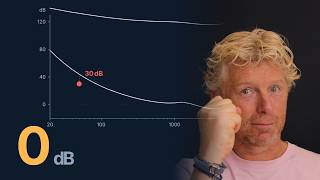 The ear and hearing threshold5:38
 Hearing damage and risk threshold6:23
About me










My name is Thomas Schuurmans, and I have a passion for physics and for understanding why things work the way they do. What I want is to get young people asking “why is that?” and “how does that work?” more often, and to hand them the tools of physics in a way that is simple and that you can see.
I graduated in applied physics at Delft University of Technology in 2003. After that I spent more than twenty years outside education: first at TNO, the Dutch applied research institute, then at a design agency, and eventually founding Proportion Global, through which I work on innovation questions in Africa, Latin America and South Asia. That work resembles physics more than you would expect: don't start from a solution, first understand what is going on, try something, be wrong, and look again.
Since 2026 I have been teaching physics to both lower and upper secondary classes, and I started a master's at the University of Amsterdam for my full teaching qualification. That is where I learned that a secondary school pupil's real attention for new material lasts about seven minutes. And my own weakness happens to be telling too many side stories.
That is where the idea came from: videos that explain one topic sharply and visually, inside those seven minutes. I make them for my own pupils. Then I publish them, because good explanation should be within reach of anyone who needs it, wherever you live and whatever language you think and speak in.