
No, no pain does not mean safe. The threshold of pain lies around 120 decibels, but hearing damage can start at 80 decibels. In between, sound damages the hair cells in your inner ear unnoticed, and they never grow back. At 80 decibels you may stay eight hours a day; every 3 decibels more halves that time.
There are also subtitles in العربية, English, Français and Türkçe. Choose your language under the gear icon in the player, at Subtitles.
No pain does not mean it is safe. The threshold of pain is around one hundred and twenty decibels, but from eighty decibels sound can already damage your hearing, and in between you notice nothing.
First you see where hearing damage sits: in the hair cells of your inner ear, which do not grow back. The ringing after a night of loud music goes away, the damage does not. Then the two numbers you have to keep apart, the risk threshold of eighty decibels and the threshold of pain of one hundred and twenty. Then the rule of thumb for the calculation: at eighty decibels you may stay in it for eight hours a day, and every three decibels more halves that time, because three decibels is twice as much sound. You work out how long you may stay in a sports hall of eighty-nine decibels, what the Dutch agreement of one hundred and three decibels at an event means, and how you see hearing damage as a dip in an audiogram. Finally, why fifteen decibels of hearing protection is more than it sounds.
For upper secondary physics, in the chapter on sound. Halfway through there is a question followed by a silence: pause the video there and think for yourself first.
In this video
- 0:00The ringing that went away
- 0:15Where the damage sits
- 0:58Eighty and one hundred and twenty
- 1:43Why three decibels halves the time
- 2:10Eighty-nine decibels
- 2:33How loud it may be at a party
- 3:01How you see that something is gone
- 4:01Fifteen decibels is a factor of thirty-two
- 4:46Summary
- 5:23The two questions
- 5:38The answers
- 6:02Closing
The full explanation, in writing
The ringing that went away
0:00After a night of loud music your ear keeps ringing. The next morning that ringing is gone, so it has recovered. Most people think so. It isn't true.
Where the damage sits
0:15In your inner ear there are thousands of hair cells that turn sound into signals for your brain. Sound that is too loud damages those hair cells. They do not grow back. A broken bone heals, a wound closes, but these hair cells do not come back.
0:31What is gone is gone. And you do not feel it happening. There are no pain nerves in them. That ringing is not the damage itself, it is your ear being briefly overloaded. But in that same night connections to your auditory nerve are lost too, and those do not come back.
0:50An ordinary hearing test does not see that, and that is why the next morning it feels as if nothing happened.
Eighty and one hundred and twenty
0:58Now two numbers, and the point is that they are two different numbers. The first is one hundred and twenty decibels: the threshold of pain. Above it sound hurts, and then you know. The second is eighty decibels: the risk threshold. From there on sound can damage your hearing.
1:16Between them lie forty decibels, and in that whole range sound does damage without letting you notice anything. No pain, no warning, impossible to repair afterwards. "It did not hurt" tells you nothing about whether it was safe. At eighty decibels you may stay in it for eight hours a day.
1:37What do you think: how long at eighty-three?
Why three decibels halves the time
1:44Four hours. And you can work that out yourself. Three decibels more means twice as much sound. What damages your ear is not the loudness alone and not the time alone, but the two together: how much sound energy has gone through in total. If it becomes twice as strong, it may last only half as long to end up at the same amount.
2:06Three decibels more, time divided by two.
Eighty-nine decibels
2:10Say you measure eighty-nine decibels in the sports hall during a tournament. You start at eighty, and that goes with eight hours. Eighty-three is one step: four hours. Eighty-six, two hours. Eighty-nine, one hour. Eighty-nine decibels, one hour.
2:27If you get two hours, you have counted two steps of three decibels instead of three.
How loud it may be at a party
2:33In the Netherlands it is agreed how loud amplified music at an event may be: one hundred and three decibels, averaged over a quarter hour. From eighty to one hundred and three is twenty-three decibels more, so halving almost eight times. Of those eight hours about two and a half minutes remain.
2:54That is a different rule from the eight hours per working day. But it does tell you where you stand if you stand at the front.
How you see that something is gone
3:02What is left of your hearing, you can measure. In a hearing test you get beep after beep, each at its own frequency, and each tone gets louder until you only just notice it. That way it is recorded per frequency how loud it had to be. What you get is a graph of your own threshold of hearing.
3:21For someone who hears well that line runs neatly along the top. With damage it drops, and not equally everywhere: there is often a dip in it, somewhere around a few thousand hertz. That is exactly where your ear is most sensitive, so that is where the sound arrives hardest and the hair cells break first.
3:42Getting older does something else: it nibbles at the highest tones, from the right. A dip in the middle comes from somewhere else. Here are two of those graphs. Which of the two would make you think of headphones, and which of age?
Fifteen decibels is a factor of thirty-two
4:02What can you do about it? Turning it down helps most, because you tackle the source. Standing further away helps too. Good hearing protection takes about fifteen decibels off, and that sounds like little. Fifteen decibels is five steps of three.
4:19Each step doubles the time, so doubling five times is a factor of thirty-two. That sports hall goes from one hour to thirty-two hours. The other way round gives the same: eighty-nine minus fifteen is seventy-four, and that is below the risk threshold of eighty.
4:37Two routes, the same answer. If you get five hours, you have multiplied by five instead of doubling five times.
Summary
4:47Four things. One: hearing damage sits in the hair cells in your inner ear, they do not grow back, and you feel nothing while it happens. Two: the threshold of pain is around one hundred and twenty decibels, the risk threshold at eighty. Between them lie forty decibels in which sound does damage without warning.
5:06Three: at eighty decibels you may stay in it for eight hours a day, and every three decibels more halves that time. Four: in an audiogram you see that damage again, as a dip in the middle. Dropping on the right-hand side goes with getting older.
The two questions
5:24Two questions. First question: at ninety-five decibels, how long may you stand there by this rule? Second question: someone says it can do no harm as long as it does not hurt. Is that right?
The answers
5:39The first: from eighty to ninety-five is fifteen decibels, so five steps of three. Starting from eight hours, halve five times: four, two, one, a half, a quarter. A quarter of an hour. The second: no. Pain only starts around one hundred and twenty decibels, damage already at eighty.
5:57Everything in between does its work in silence, so your ear does not warn you.
Closing
6:03You can now work out how long you may stay somewhere, and you know why the ringing goes away while the damage stays. On the channel there is a separate video about why a sound that is twice as strong does not sound twice as loud.
Frequently asked questions
From how many decibels do you get hearing damage?
From about 80 decibels, sound can damage your hearing. That is the risk threshold. At 80 decibels you may stay in it for eight hours a day; the louder it is, the shorter that becomes. The threshold of pain is much higher, around 120 decibels, so pain is no warning.
How long can you stay at 89 dB?
One hour. Start at 80 decibels and eight hours. Every 3 decibels more halves the time: 83 decibels is four hours, 86 decibels two hours, 89 decibels one hour. If you get two hours, you have counted two steps of 3 decibels instead of three.
Why does the time halve with 3 dB more?
Because 3 decibels more is twice as much sound. What damages your ear is the total amount of sound energy, so loudness and time together. If the sound is twice as strong, you reach the same amount in half the time.
If the ringing after a party goes away, does that mean your ear has recovered?
No. The ringing is your ear being temporarily overloaded, and that goes away. But damaged hair cells and connections to the auditory nerve do not come back. An ordinary hearing test does not see those connections, so the next morning it feels as if nothing happened.
How much does 15 dB of hearing protection help?
A factor of 32 in time. Fifteen decibels is five steps of 3 decibels, and each step doubles the time you may stay: doubling five times is 32 times as long. In a sports hall of 89 decibels you go from one hour to 32 hours. Five hours is wrong: then you multiplied by five instead of doubling five times.
How do you see hearing damage in an audiogram?
As a dip in the line, often around a few thousand hertz. That is where your ear is most sensitive, so that is where loud sound arrives hardest. Getting older looks different: then the line drops on the right-hand side, at the highest tones.
Fifteen decibels less is not five times as long, but thirty-two times.
Physics with Thomas makes physics explainers for secondary school. No words on screen, so what you see works in any language.
In this series
 Sound and vibrationwhat you hear is not the air from his mouth6:53
 Frequency, amplitude and pitchlouder is not higher5:57
 Resonance and vibrating alongit is timing, not force6:17
 Fundamental, overtones and timbresame tone, other sound6:06
 The tone of an air columnf = v divided by 4L3:15
 Decibels and loudness80 dB is not twice 40 dB3:31
 Loudness and distancetwice as far, four times quieter3:27
 Anti-noisemore sound and yet quieter2:31
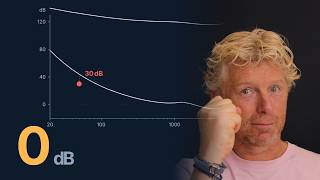 The ear and hearing thresholdzero decibels is not silence5:38
 Hearing damage and risk thresholdno pain does not mean safe6:23
About me










My name is Thomas Schuurmans, and I have a passion for physics and for understanding why things work the way they do. What I want is to get young people asking “why is that?” and “how does that work?” more often, and to hand them the tools of physics in a way that is simple and that you can see.
I graduated in applied physics at Delft University of Technology in 2003. After that I spent more than twenty years outside education: first at TNO, the Dutch applied research institute, then at a design agency, and eventually founding Proportion Global, through which I work on innovation questions in Africa, Latin America and South Asia. That work resembles physics more than you would expect: don't start from a solution, first understand what is going on, try something, be wrong, and look again.
Since 2026 I have been teaching physics to both lower and upper secondary classes, and I started a master's at the University of Amsterdam for my full teaching qualification. That is where I learned that a secondary school pupil's real attention for new material lasts about seven minutes. And my own weakness happens to be telling too many side stories.
That is where the idea came from: videos that explain one topic sharply and visually, inside those seven minutes. I make them for my own pupils. Then I publish them, because good explanation should be within reach of anyone who needs it, wherever you live and whatever language you think and speak in.