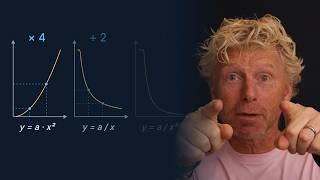
A straight line is linear, but only directly proportional when it goes through the origin: then y = a · x, and twice as much x gives twice as much y. You recognise a curve not by its shape but by doubling x: four times bigger is proportional to the square, twice smaller is inversely proportional.
This video can also be listened to in العربية, English, Español, Français, Português and Türkçe. There are also subtitles in Kiswahili. Choose your language under the gear icon in the player, at Audio track and Subtitles.
You drive twice as fast and you brake. Does your braking distance become twice as long, or four times? Do not work it out, choose. Almost everyone goes for twice, because proportionality is the only shape we assume automatically. The answer is four.
In this video you learn which relationship you see in a graph and which constant belongs with it. First the difference between linear and directly proportional, because those are not the same: a straight line is linear, but only when it also goes through the origin may you say that twice as much gives twice as much. With the height of a stack of books above the floor that does not hold, because there is a table underneath.
Then the four curves you must recognise: proportional to the square, inversely proportional, inversely proportional to the square, and the square-root relationship. You do not recognise them by how they look, because curved is curved. You recognise them by comparing two points: take an x twice as big and see what y does. Four times bigger, twice smaller, four times smaller, or root two times bigger.
And finally the constant a. You determine it from several points and never from one, because one point always gives you a number, even when you chose the wrong relationship. Then look at its unit, because that tells you what the constant actually is.
For upper secondary physics, in the basic skills.
In this video
The full explanation, in writing
Braking at twice the speed
0:00You drive twice as fast and you brake. Does your braking distance become twice as long, or four times? Do not work it out. Choose.
Linear is not the same as directly proportional
0:13Start with the straight line, because there are two different things in it. I had measured the height of my stack of books above the floor. That graph is a straight line, but it starts at seventy-four centimetres, because that is my table. For a straight line: y is a times x, plus b.
0:34That is called a linear relationship. The a is the gradient, the b is where you cut the vertical axis. If instead I measure the height of the stack itself, the table drops out. Zero books, zero centimetres, so my line goes through the origin.
0:52Then b is zero, and I am left with: y is a times x. That is the special case, and it has a name of its own: a directly proportional relationship. Twice as many books gives really twice as much height. With the first graph that does not hold, because that table sits underneath it.
Recognising the four curves
1:13If your graph is not straight, there are four shapes you must recognise. And you do not recognise them by how they look, because curved is curved. You recognise them by comparing two points. Take an x that is twice as big, and see what y does.
1:30If y becomes four times as big, it is proportional to the square: y is a times x squared. That is the braking distance, and the answer was four times. If y becomes twice as small, it is inversely proportional: y is a divided by x. Think of a journey of fixed length: driving twice as fast is half the time.
1:55If y gets four times smaller, it is inversely proportional to the square: y is a divided by x squared. That is a lamp's light as you stand further away. And if y becomes only root two times as big, there is a square-root relationship: y is a times the square root of x.
2:17Such as the time something needs to fall. You measure and you see: if x becomes twice as big, y becomes four times as small. Which relationship is that?
Determining the constant a
2:29If you know which relationship, you can work out the constant a. And that can be done two ways. From your table: work a out for each measurement apart, and take the average of those. Or your graph: choose two points that do not lie too close together, work a out for both, and if they differ, take a third one as well.
2:53I drove a hundred and twenty kilometres. At forty kilometres per hour that took three hours, at sixty two hours, at eighty one and a half hours. That is inversely proportional, so a is v times t. Forty times three is a hundred and twenty. Sixty times two is a hundred and twenty.
3:12Eighty times one and a half is a hundred and twenty. So a is a hundred and twenty kilometres, and that is exactly the distance I drove. If you get zero point zero seven five, you have divided the time by the speed instead of multiplying. Because that is the beauty of that constant: it is almost never only a number.
3:34Its unit tells you what it is.
Three things to remember
3:38Three things. The straight line is linear; if it also goes through the origin, then it is directly proportional, and only then may you say that twice as much also gives twice as much. Curves you recognise by doubling x and seeing what y does: four times bigger, twice smaller, four times smaller, or root two times bigger.
4:00And the constant you get from several points, never from one. Then look at its unit, because that says what it means.
Two questions
4:09Two questions. One. The graph is a perfectly straight line, but it cuts the vertical axis at five. May you say that y is directly proportional to x? Two. You double x and y becomes four times as big. You work a out with one point and you get three.
4:36What do you do now?
The answers
4:38The first: no. It is linear, but not directly proportional, because it does not go through the origin. Just double x: y does not become double, because that five simply stays added on. The second: you take a second point as well. One point always gives you a number, even if you chose the wrong relationship.
4:59Only when two points give the same a do you know you are right.
Closing
5:04Curved graphs are awkward for reading a constant off. Once you want that curve straight, without changing one measurement, this is exactly what you need.
Frequently asked questions
What is the difference between linear and directly proportional?
A straight line is linear: y = a·x + b. It is directly proportional only when it also goes through the origin, so when b is zero. Only then does twice as much x give twice as much y.
How do you recognise which relationship a curved graph has?
By comparing two points, not by its shape. Take an x twice as big and see what y does. Four times bigger is proportional to the square, twice smaller is inversely proportional, four times smaller is inversely proportional to the square, and root two times bigger is a square-root relationship.
Why may you not determine the constant a from one point?
Because one point always gives you a number, even when you chose the wrong relationship. Only when two points give the same a do you know you are right. If they differ, take a third one as well.
Why does your braking distance become four times as long at twice the speed?
Because braking distance is proportional to the square of speed: y = a·x². Doubling x makes y four times as big. That is the shape we do not assume automatically, and it is why the intuitive answer of twice is wrong.
What does the unit of the constant tell you?
What the constant actually is. In a journey of fixed length the constant is speed times time, and its unit is kilometres, which is exactly the distance driven. The constant is almost never only a number.
Before this came how you make a graph from a series of measurements and lay a line of best fit through it.
This video carries audio and subtitles in several languages. Pick yours under the gear icon in the player, at Audio track and at Subtitles.
Physics with Thomas: physics explained with pictures where they add something, and without them where they distract.
In this series
 Quantities and units7:30
 Ratios and percentages3:15
 Scientific notation5:22
 Calculating with powers of ten3:18
 Pythagoras and trigonometry3:19
 Deriving units from a formula7:47
 Significant figures6:24
 Line of best fit5:07
 Relationships and the constant5:20
 Linearising a graph4:41
About me










My name is Thomas Schuurmans, and I have a passion for physics and for understanding why things work the way they do. What I want is to get young people asking “why is that?” and “how does that work?” more often, and to hand them the tools of physics in a way that is simple and that you can see.
I graduated in applied physics at Delft University of Technology in 2003. After that I spent more than twenty years outside education: first at TNO, the Dutch applied research institute, then at a design agency, and eventually founding Proportion Global, through which I work on innovation questions in Africa, Latin America and South Asia. That work resembles physics more than you would expect: don't start from a solution, first understand what is going on, try something, be wrong, and look again.
Since 2026 I have been teaching physics to both lower and upper secondary classes, and I started a master's at the University of Amsterdam for my full teaching qualification. That is where I learned that a secondary school pupil's real attention for new material lasts about seven minutes. And my own weakness happens to be telling too many side stories.
That is where the idea came from: videos that explain one topic sharply and visually, inside those seven minutes. I make them for my own pupils. Then I publish them, because good explanation should be within reach of anyone who needs it, wherever you live and whatever language you think and speak in.